- You are here:
- Home

- Conferences
- Education
- Translational Control - From Cells to Organisms
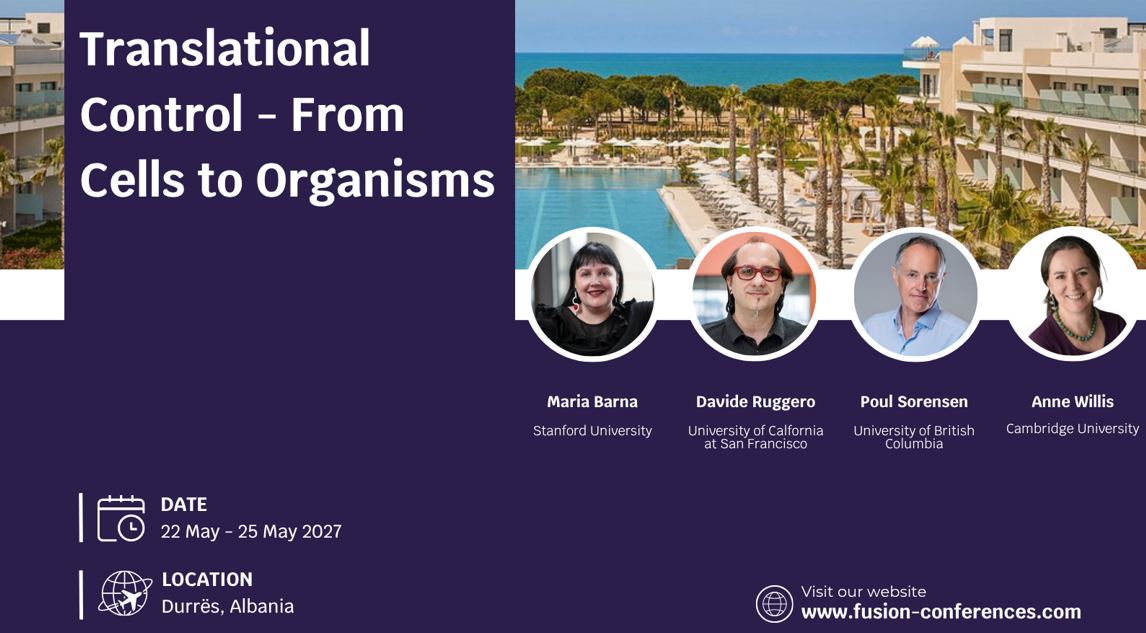
Translational Control - From Cells to Organisms
TCCO
Date of beginning
Friday, 22 May 2026Duration
4 daysDeadline for abstracts
Thursday, 19 November 2026City
DurrësCountry
AlbaniaContact
Amy LacamExpected participants
100Memo
Protein synthesis is one of the most energy-intensive and highly regulated processes in biology, yet its role as a dynamic driver of cellular and organismal function remains underexplored. This meeting will bring together investigators studying translational control across scales - from molecular mechanisms within cells to tissue-level physiology, cancer biology, therapeutic intervention, and organismal adaptation. The goal is to define how regulation at the level of mRNA translation shapes cell identity, developmental transitions, stress responses, disease states, and organismal fitness. A central focus will be how cells selectively remodel translation in response to changing environments. Topics will include: Translational control in stress adaptation Nutrient sensing Proteostasis Immune activation, regeneration & aging Metabolic disease & cancer Cancer will serve as a key example of how translational rewiring enables cells to survive oncogenic stress, adapt to nutrient limitation, evade therapy, remodel proteostasis, and support metastatic progression. Particular emphasis will be placed on how translational programs are regulated in vivo, where cell–cell interactions, tissue architecture, developmental timing, immune pressure, and organismal physiology impose regulatory constraints that are not captured in simplified cell culture systems. The meeting will also highlight emerging concepts in ribosome heterogeneity and translation specialization. Rather than acting as passive, uniform machines, ribosomes are increasingly understood to vary in composition, modification state, localization, and associated regulatory factors. These specialized ribosomes may preferentially translate distinct classes of mRNAs, creating an additional layer of gene regulation embedded within the translational machinery itself. Sessions will explore how ribosome composition, RNA features, initiation factors, localized translation, and ribosome-associated proteins contribute to selective protein synthesis in specific cellular, tissue, developmental, and disease contexts. A major objective will be to connect fundamental mechanisms of translational control to therapeutic opportunities. Because translational regulation can determine which proteins are made, when, where, and in what cellular state, it offers a powerful but still underdeveloped entry point for intervention. The meeting will explore how targeting translation initiation, elongation, ribosome function, RNA regulatory elements, stress-response pathways, and specialized translational programs could open new therapeutic strategies for cancer and other diseases. By integrating mechanistic, genomic, imaging, proteomic, developmental, disease-focused, and organismal approaches, this meeting will define translational control as a major regulatory axis in biology and medicine. It will provide a forum to connect researchers working on fundamental mechanisms of protein synthesis with those studying physiology, development, cancer, stress adaptation, and therapeutic intervention. Ultimately, the meeting aims to move the field beyond viewing translation as a downstream output of transcription and toward a new framework in which translational regulation actively determines cellular behaviour, tissue function, disease progression, and organismal adaptation.